| |
|
| Knowledge Center |
| |
| What is a Mutual Fund? |
The following are some of the more popular definitions of a Mutual Fund
A Mutual Fund is an investment tool that allows small investors access to a well-diversified
portfolio of equities, bonds and other securities. Each shareholder participates
in the gain or loss of the fund. Units are issued and can be redeemed as needed.
The fund's Net Asset Value (NAV) is determined each day.
Mutual Funds are financial intermediaries. They are companies set up to receive
your money, and then having received it, make investments with the money Via
an AMC. It is an ideal tool for people who want to invest but don't want to be
bothered with deciphering the numbers and deciding whether the stock is a good
buy or not. A mutual fund manager proceeds to buy a number of stocks from various
markets and industries. Depending on the amount you invest, you own part of the
overall fund.
The beauty of mutual funds is that anyone with an investible surplus of a few
hundred rupees can invest and reap returns as high as those provided by the equity
markets or have a steady and comparatively secure investment as offered by debt
instruments. |
| |
| What are the benefits of investing in a Mutual Fund? |
There are several benefits from investing in a Mutual Fund.
- Small investments : Mutual funds help you to reap the
benefit of returns by a portfolio spread across a wide spectrum of companies
with small investments. Such a spread would not have been possible without
their assistance.
- Professional Fund Management : Professionals having considerable
expertise, experience and resources manage the pool of money collected by
a mutual fund. They thoroughly analyse the markets and economy to pick good
investment opportunities.
- Spreading Risk : An investor with a limited amount of
fund might be able to to invest in only one or two stocks / bonds, thus increasing
his or her risk. However, a mutual fund will spread its risk by investing
a number of sound stocks or bonds. A fund normally invests in companies across
a wide range of industries, so the risk is diversified at the same time taking
advantage of the position it holds. Also in cases of liquidity crisis where
stocks are sold at a distress, mutual funds have the advantage of the redemption
option at the NAVs.
- Transparency and interactivity : Mutual Funds regularly
provide investors with information on the value of their investments. Mutual
Funds also provide complete portfolio disclosure of the investments made
by various schemes and also the proportion invested in each asset type. Mutual
Funds clearly layout their investment strategy to the investor.
- Liquidity : Closed ended funds have their units listed
at the stock exchange, thus they can be bought and sold at their market value.
Over and above this the units can be directly redeemed to the Mutual Fund
as and when they announce the repurchase.
- Choice : The large amount of Mutual Funds offer the investor
a wide variety to choose from. An investor can pick up a scheme depending
upon his risk / return profile.
- Regulations : All the mutual funds are registered with
SEBI and they function within the provisions of strict regulation designed
to protect the interests of the investor.
|
| |
A Mutual Fund is not an alternative investment option to stocks and bond; rather
it pools the money of several investors and invests this in stocks, bonds, money
market instruments and other types of securities.
A Mutual Fund is a trust that pools the savings of a number of investors who
share a common financial goal. The money thus collected is then invested in capital
market instruments such as shares, debentures and other securities. The income
earned through these investments and the capital appreciation realised are shared
by its unit holders in proportion to the number of units owned by them. Thus
a Mutual Fund is the most suitable investment for the common man as it offers
an opportunity to invest in a diversified, professionally managed basket of securities
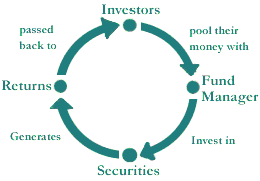
at a relatively low cost. The flow chart below describes broadly the working
of a mutual fund :
CONCEPT
Mutual Fund Operation Flow Chart |
|
| |
| What does a Mutual Fund do with investor's money? |
| Anybody with an investible surplus of as little as a few hundred rupees can invest
in mutual funds. The investors buy units of a fund that best suits their investment
objectives and future needs. A Mutual Fund invests the pool of money collected
from the investors in a range of securities comprising equities, debt, money
market instruments etc. after charging for the AMC fees. The income earned and
the capital appreciation realised by the scheme, are shared by the investors
in same proportion as the number of units owned by them. |
| |
| How are Mutual Funds different from portfolio management schemes? |
| In case of mutual funds, the investments of different investors are pooled to
form a common investible corpus and gain/loss to all investors during a given
period are same for all investors while in case of portfolio management scheme,
the investments of a particular investor remains identifiable to him. Here the
gain or loss of all the investors will be different from each other. |
| |
| How is investment in a Mutual Fund Different from a Bank Deposit? |
| When you deposit money with the bank, the bank promises to pay you a certain
rate of interest for the period you specify. On the date of maturity, the bank
is supposed to return the principal amount and interest to you. Whereas, in a
mutual fund, the money you invest, is in turn invested by the manager, on your
behalf, as per the investment strategy specified for the scheme. The profit,
if any, less expenses of the manager, is reflected in the NAV or distributed
as income. Likewise, loss, if any, with the expenses, is to be borne by you. |
| |
| What are the types of returns one can expect from a Mutual Fund? |
Mutual Funds give returns in two ways - Capital Appreciation or Dividend Distribution.
Capital Appreciation : An increase in the value of the units of the fund is known
as capital appreciation. As the value of individual securities in the fund increases,
the fund's unit price increases. An investor can book a profit by selling the
units at prices higher than the price at which he bought the units.
Dividend Distribution : The profit earned by the fund is distributed among unit
holders in the form of dividends. Dividend distribution again is of two types.
It can either be re-invested in the fund or can be on paid to the investor. |
| |
| How are Mutual Funds classified? |
| |
| Why do Mutual Funds come out with different schemes? |
| A Mutual Fund may not, through just one portfolio, be able to meet the investment
objectives of all their Unit holders. Some Unit holders may want to invest in
risk-bearing securities such as equity and some others may want to invest in
safer securities such as bonds or government securities. Hence, the Mutual Fund
comes out with different schemes, each with a different investment objective. |
| |
| Does investing in Mutual Funds mean investing in equities only? |
Mutual Funds can be divided into various types depending on asset classes. They
can also invest in debt instruments such as bonds, debentures, commercial paper
and government securities apart from equity.
Every mutual fund scheme is bound by the investment objectives outlined by it
in its prospectus. The investment objectives specify the class of securities
a mutual fund can invest in. |
| |
| What are sector funds? |
| These are speciality mutual funds that invest in stocks that fall into a certain
sector of the economy. Here the portfolio is dispersed or spread across the stocks
in a particular sector.This type of scheme is ideal for the investor who has
already made up his mind to confine his risk and return to one particular sector.
Thus, a FMCG fund would invest in companies that manufacture fast moving consumer
goods. |
| |
| What is the difference between Growth Plan and Dividend Reinvestment Plan? |
| Under the Growth Plan, the investor realizes the capital appreciation of his/her
investments while under the Dividend Reinvestment Plan, the dividends declared
are reinvested automatically in the scheme. |
| |
| What is a Portfolio? |
| A portfolio of a mutual fund scheme is the basket of financial assets held by
that scheme. It comprises of investments in a variety of securities and asset
classes. This diversification helps reduces the overall risk. A mutual fund scheme
states the kind of portfolio it seeks to construct as well as the risks involved
under each asset class. |
| |
| What is Net Asset Value (NAV)? |
| Net Asset Value (NAV) is the actual value of one unit of a given scheme on any
given business day. The NAV reflects the liquidation value of the fund's investments
on that particular day after accounting for all expenses. It is calculated by
deducting all liabilities (except unit capital) of the fund from the realisable
value of all assets and dividing it by number of units outstanding. |
| |
|
| |
| What is a load? |
The charge collected by a Mutual Fund from an investor for selling the units
or investing in it.
When a charge is collected at the time of entering into the scheme it is called
an Entry load or Front-end load or Sales load. The entry load percentage is added
to the NAV at the time of allotment of units.
An Exit load or Back-end load or Repurchase load is a charge that is collected
at the time of redeeming or for transfer between schemes (switch). The exit load
percentage is deducted from the NAV at the time of redemption or transfer between
schemes.
Some schemes do not charge any load and are called "No Load Schemes" |
| |
| What is a Sale Price? |
| It is the price paid by an investor when investing in a scheme of a Mutual Fund.
This price may include the sales or entry load. |
| |
| What is a Redemption/Repurchase Price? |
| Redemption or Repurchase Price is the price at which an investor sells back the
units to the Mutual Fund. This price is NAV related and may include the exit
load. |
| |
What is a Redemption/Repurchase Price?
Redemption or Repurchase Price is the price at which an investor sells back the
units to the Mutual Fund. This price is NAV related and may include the exit
load.
What is the Repurchase or Back End Load?
It is the charge collected by the scheme when it buys back the units from the
unit holders.
What is a Switching Facility?
Switching facility provides investors with an option to transfer the funds amongst
different types of schemes or plans. Investors can opt to switch units between
Dividend Plan and Growth Plan at NAV based prices. Switching is also allowed
into/from other select open-ended schemes currently within the Fund family or
schemes that may be launched in the future at NAV based prices.
While switching between Debt and Equity Schemes, one has to take care of exit
and entry loads. Switching from a Debt Scheme to Equity scheme involves an entry
load while the vice versa does not involve an entry load.
What is the applicable NAV for switch?
Switch requests are effected the day the request for switch is received. The
Applicable NAV for the switch will be the NAV on the day that the request for
switch is received
What is an Account Statement?
An Account Statement is a non-transferable document that serves as a record of
transactions between the fund and the investor. It contains details of the investor,
the units allotted or redeemed and the date of transaction. The Account Statement
is issued every time any transaction takes place.
Who is a Registrar?
A Registrar accepts and processes unitholders' applications, carries out communications
with them, resolves their grievances and despatches Account Statements to them.
In addition, the registrar also receives and processes redemption, repurchase
and switch requests. The Registrar also maintains an updated and accurate register
of unitholders of the Fund and other records as required by SEBI Regulations
and the laws of India. An investor can get all the above facilities at the Investor
Service Centres of the Registrar.
Who is a custodian?
Custodian is the agency which will have the physical possession of all the securities
purchased by the mutual fund.
How do I track the performance of the Fund?
The NAVs are published in financial newspapers and also available on the AMFI
website on a daily basis.
Can the NAV of a debt fund fall?
A debt fund invests in fixed-income instruments, where safety of capital and
regular returns are assured. These include Commercial Paper, Certificates of
Deposit, debentures and bonds. While the rate of interest on these instruments
stays the same throughout their tenure, their market value keeps changing, depending
on how the interest rates in the economy move.
A debt fund's NAV is the market value of its portfolio holdings at a given point
in time. As interest rates change, so do the market value of fixed-income instruments
- and hence, the NAV of a debt fund. Thus it is a misnomer that the debt fund's
NAV does not fall.
What is a Systematic Investment Plan?
This is an investment technique where you deposit a fixed, small amount regularly
into the mutual fund scheme (every month or quarter as per your convenience)
at the then prevailing NAV (Net Asset Value), subject to applicable load.
What is a Systematic Withdrawal Plan?
The unitholder may set up a Systematic Withdrawal Plan on a monthly, quarterly
or semi-annual or annual basis to redeem a fixed number of units.
Besides the NAV, are there any other parameters which can be compared across
different funds of the same cateogry?
Besides Net Asset Value the following parameters should be considered while comparing
the funds :
AVERAGE RETURNS An investor should look at the returns given by the fund over
a period of time. Care should be taken to see whether all dividends and bonuses
have been accounted for. The higher and more consistent the returns the better
is the fund.
VOLATILITY In addition to the returns one should also look at the volatility
of the returns given by the fund. Volatility is essentially the fluctuation of
the returns about the mean return over a period of time. A fund giving consistent
returns is better than a fund whose returns fluctuate a lot.
CORPUS SIZE : A Large corpus is generally considered good because large funds
have lower costs, as expenses are spread over large assets but at the same time
a large corpus has some inefficiencies too. A large corpus may become unwieldy
and thus difficult to manage.
PERFORMANCE VIS A VIS BENCHMARK OTHER SCHEMES An investor should not only look
at the returns given by the scheme he has invested in but also compare it with
benchmarks like BSE Sensex, S & P Nifty, T-bill index etc depending on the
asset class he has invested in. For a true picture it is advised that the returns
should also be compared with the returns given by the other funds in the same
category.
Thus it is prudent to consider all the above-mentioned factors while comparing
funds and not rely on any one of them in isolation. This is important because
as of today there is no standard method for evaluation of un-traded securities.
What is CDSC?
Contingent Deferred Sales Charge (CDSC) is a charge imposed on unit holders exiting
from the scheme within 4 years of entry. It is intended to enable the AMC to
recover expenses incurred for promotion or propagation of the scheme.
Or
Sometimes the selling expenses of the fund are not charged to the fund directly
but are recovered from the unit holders whenever they redeem their units. This
load is called a CDSC and is inversely proportional to the period of unit holding.
What is the difference between contigent defered sales load and an exit load?
Contingent Deferred Sales charge (CDSC) is a charge imposed when the units of
a fund are redeemed during the first few years of ownership. Under the SEBI Regulations,
a fund can charge CDSC to unit holders exiting from the scheme within the first
four years of entry.
Exit load is a fee an investor pays to a fund whenever he redeems his/her units.
As per SEBI regulations, the maximum exit load applicable is 7%. There is a further
stipulation by SEBI that the entry load and exit load put together cannot exceed
7% of the sale price.
Does out performance of a benchmark index always connote good performance?
No, it is not necessary that out performance of a benchmark index always connotes
good performance. The volatility does not permit the investor to rely on one
factor only. The index performance is volatile and may be driven by a few scrips
only, which may not be very reflective. So it is better to keep other factors
like risk adjusted returns (volatility of returns) and NAV movement in mind while
deciding to invest in a fund.
Does higher return necessarily mean a better fund?
Yes, on the face of it high return does connote good fund but there is also some
a risk taken by the scheme to achieve these returns. Thus it is prudent to measure
risk alsowhile considering returns to rank a scheme. Today there are a lot of
statistical tools like Beta, Sharpe ratio, Alpha and Standard Deviation to measure
this risk. A risk adjusted return is the best measure to use while judging a
scheme. You can also refer to the ratings assigned by a reputed rating agency.
What should one keep in mind while choosing a good Mutual Fund?
Each individual has different financial goals, based on lifestyle, financial
independence and family commitments and level of incomes and expenses and many
other factors. Thus before investing your money you need to analyze the following
factors :
- Define the Investment objective
Your financial goals will vary, based on your age, lifestyle, financial
independence, family commitments and level of income and expenses
among many other factors. Therefore, the first step should be
to assess your needs. You can begin by defining the investment
objectives, which could be regular income, buying a home or finance
a wedding or educate your children or a combination of all these
needs. Also your risk appetite and cash flow requirements need
to be taken into account.
- Choose the right Mutual Fund
Once the investment objective is clear in your mind the next step
is choosing the right Mutual Fund scheme. Before choosing a mutual
fund the following factors need to be considered:
- NAV performance in the past track record of performance in terms
of returns over the last few years in relation to appropriate yardsticks
and other funds in the same category.
- Risk in terms of volatility of returns
- Services offered by the mutual fund and how investor friendly
it is.
- Transparency, which is reflected in the quality and frequency
of its communications.
Go for a proper combination of schemes
Investing in just one Mutual Fund scheme may not meet all your investment needs.
You may consider investing in a combination of schemes to achieve your specific
goals.
What is meant by recurring sales expenses?
The Asset management Company may charge the fund a fee for operating its schemes,
like trustee fee, custodian fee, registrar fee, transfer fee etc. This fee is
called recurring expense and is expressed as a percentage of the scheme's average
net assets. The recurring expenses are subject to certain limits as per the regulations
of SEBI.
| WEEKLY AVERAGE NET ASSETS RS. |
EQUITY SCHEMES |
DEBT SCHEMES |
| FIRST 100 CRORES |
2.50% |
2.25% |
| NEXT 300 CRORES |
2.25% |
2.00% |
| NEXT 300 CRORES |
2.00% |
1.75% |
| BALANCE ASSETS |
1.75% |
1.50% |
Debt Funds FAQs
What are Money Markets and money market instruments?
Money markets allow banks to manage their liquidity as well as provide the Central
Bank means to conduct monetary policy. Money markets are markets for debt instruments
with a maturity up to one year.
The most active part of the money market is the call money market (i.e. market
for overnight and term money between banks and institutions) and the market for
repo transactions. The former is in the form of loans and the latter are sale
and buyback agreements - both are obviously not traded. The main traded instruments
are Commercial Papers (CPs), Certificates of Deposit (CDs) and Treasury Bills
(T-Bills).
Commercial Paper
A Commercial Paper is a short term unsecured promissory note issued by the raiser
of debt to the investor. In India Corporates, Primary Dealers (PD), Satellite
Dealers (SD) and Financial Institutions (FIs) can issue these notes.
It is generally companies with very good ratings which are active in the CP market,
though RBI permits a minimum credit rating of Crisil-P2. The tenure of CPs can
be anything between 15 days to one year, though the most popular duration is
90 days. Companies use CPs to save interest costs
Certificates of Deposit
These are issued by banks in denominations of Rs 5 lakhs and have maturity ranging
from 30 days to 3 years. Banks are allowed to issue CDs with a maturity of less
than one year while financial institutions are allowed to issue CDs with a maturity
of at least one year.
Treasury Bills
Treasury Bills are instruments issued by RBI at a discount to the face value
and form an integral part of the money market. In India Treasury Bills are issued
in four different maturities - 14 days, 90 days, 182 days and 364 days.
Apart from the above money market instruments, certain other short-term instruments
are also in vogue with investors. These include short-term corporate debentures,
bills of exchange and promissory notes.
What are debt markets and debt market instruments?
Typically those instruments that have a maturity of more than a year and the
main types are -
Government Securities (G-secs or Gilts)
- Like T-bills, gilts are issued by RBI on behalf of the Government.
These instruments form a part of the borrowing program approved
by Parliament in the Finance Bill each year (Union Budget). Typically,
they have a maturity ranging from 1 year to 20 years.
- Like T-Bills, Gilts are issued through the auction route but
RBI can sell/buy securities in its Open Market Operations (OMO)
. OMOs include conducting repos as well and are used by RBI to
manipulate short-term liquidity and thereby the interest rates
to desired levels
The other types of Government Securities are
- Inflation linked bonds
- Zero coupon bonds
- State Government Securities (State Loans)
Bonds/Debentures
What is the difference between bonds and debentures?
World over, a debenture is a debt security issued by a corporation that is not
secured by specific assets, but rather by the general credit of the corporation.
Stated assets secure a corporate bond, unlike a debenture. But in India these
are used interchangeably.
A bond is a promise in which the issuer agrees to pay a certain rate of interest,
usually as a percentage of the bond's face value to the investor at specific
periodicity over the life of the bond. Sometimes interest is also paid in the
form of issuing the instrument at a discount to face value and subsequently redeeming
it at par. Some bonds do not pay a fixed rate of interest but pay interest that
is a mark-up on some benchmark rate.
Typically bonds are issued by PSUs, Public Financial Institutions and Corporates.
Another distinction is SLR (Statutory Liquidity Ratio) and non-SLR bonds. SLR
bonds are those bonds which are approved securities by RBI which fall under the
SLR limits of banks.
Statutory liquidity ratio(SLR): It is the percentage of total deposits a bank
has to keep in approved securities.
What affects bond prices?
Largely it will be the interest rates and credit quality of the issuer.
- Interest Rates : The price of a debenture is inversely
proportional to changes in interest rates that in turn is dependent on various
factors. When the interest rates fall down, the existing bonds will become
more valuable and the prices will move up until the yields become the same
as the new bonds issued during the lower interest rate scenario(for a detailed
explanation see "what affects interest rates").
- Credit Quality : When the credit quality of the issuer
deteriorates, market expects higher interest from the company and the price
of the bond falls and vice versa.
Another factor that determines the sensitivity of a bond is the "Maturity
Period" - a longer maturity instrument will rise or fall more than a shorter
maturity instrument.
What affects interest rates?
The factors are largely macro-economic in nature -
- Demand/Supply of money : When economic growth is high,
demand for money increases, pushing the interest rates up and vice versa.
- Government Borrowing and Fiscal Deficit : Since the government
is the biggest borrower in the debt market, the level of borrowing also determines
the interest rates.
On the other hand, supply of money is done by the Central Bank by either
printing more notes or through its Open Market Operations (OMO).
- RBI : RBI can change the key rates (CRR, SLR and bank
rates) depending on the state of the economy or to combat inflation. RBI
fixes the bank rate which forms the basis of the structure of interest rates
and the Cash Reserve Ratio (CRR) and Statutory Liquidity Ratio (SLR), which
determines the availability of credit and the level of money supply in the
economy.
(CRR is the percentage of its total deposits a bank has to keep with RBI
in cash or near cash assets and SLR is the percentage of its total deposits
a bank has to keep in approved securities. The purpose of CRR and SLR is
to keep a bank liquid at any point of time. When banks have to keep low CRR
or SLR, it increases the money available for credit in the system. This eases
the pressure on interest rates and interest rates move down. Also when money
is available and that too at lower interest rates, it is given on credit
to the industrial sector that pushes the economic growth)
- Inflation Rate : Typically a higher inflation rate means
higher interest rates. The interest rates prevailing in an economy at any
point of time are nominal interest rates, i.e., real interest rates plus
a premium for expected inflation. Due to inflation, there is a decrease in
purchasing power of every rupee earned on account of interest in the future;
therefore the interest rates must include a premium for expected inflation.
In the long run, other things being equal, interest rates rise one for one
with rise in inflation.
What is Yield Curve?
The relationship between time and yield on securities is called the Yield Curve.
The relationship represents the time value of money - showing that people would
demand a positive rate of return on the money they are willing to part today
for a payback into the future.
A yield curve can be positive, neutral or flat.
- A positive yield curve, which is most natural, is when the slope of the
curve is positive, i.e. the yield at the longer end is higher than that at
the shorter end of the time axis. This is as a result of people demanding
higher compensation for parting their money for a longer time into the future.
- A neutral yield curve is that which has a zero slope, i.e. is flat across
time. This occurs when people are willing to accept more or less the same
returns across maturities.
- The negative yield curve (also called an inverted yield curve) is one of
which the slope is negative, i.e. the long-term yield is lower than the short-term
yield. It is not often that this happens and has important economic ramifications
when it does. It generally represents an impending downturn in the economy,
where people are anticipating lower interest rates in the future.
What is Yield to Maturity (YTM)?
Simply put, the annualised return an investor would get by holding a fixed income
instrument until maturity. It is the composite rate of return of all payouts
and coupon.
What is Average Maturity Period?
It is a weighted average of the maturities of all the instruments in a portfolio.
What are LIBOR and MIBOR?
LIBOR : Stands for London Inter Bank Offered rate. This is a very popular benchmark
and is issued for US Dollar, GB Pound, Euro, Swiss Franc, Canadian Dollar and
the Japanese Yen. The British Bankers Association (BBA) asks 16 banks to contribute
the LIBOR for each maturity and for each currency. The BBA weeds out the best
four and the worst four, calculates the average of the remaining eight and the
value is published as LIBOR.
MIBOR : Stands for Mumbai Inter Bank Offered Rate and is closely modeled on the
LIBOR. Currently there are two calculating agents for the benchmark - Reuters
and the National Stock Exchange (NSE). The NSE MIBOR benchmark is the more popular
of the two and is based on rates polled by NSE from a representative panel of
31 banks/institutions/primary dealers
Credit Ratings
What is a credit rating ?
Credit Rating is an exercise conducted by a rating organisation to evaluate the
credit worthiness of the issuer with respect to the instrument being issued or
a general ability to pay back debt over the specified period of time. The rating
is given as an alphanumeric code that represents a graded structure or creditworthiness.
Typically the highest credit rating is that of AAA and the lowest being D (for
default). Within the same alphabet class, the rating agency might have different
grades like A, AA and AAA and within the same grade AA+, AA- where the "+" denotes
better than AA and "-" indicates the opposite. For short term instruments
of less than a year maturity, the rating symbol would be typically "P" (varies
depending on the rating agency).
In India, currently we have four rating agencies -
What is the "SO" in a rating ? [AAA(SO)]
Sometimes, debt instruments are so structured that in case the issuer is unable
to meet repayment obligations, another entity steps in to fulfill these obligations.
A bond backed by the guarantee of the Government of India may be rated AAA (SO)
with the SO standing for structured obligation
Forex Markets
How is a currency valued?
The floating exchange rate system is a confluence of various demand and supply
factors prevalent in an economy like -
- Current account balance : The trade balance is the difference
between the value of exports and imports. If India is exporting
more than it is importing, it would have a positive trade balance
with USA, leading to a higher demand for the home currency. As
a result the demand will translate into appreciation of the currency
and vice versa.
- Inflation rate : Theoretically, the rate of change in exchange
rate is equal to the difference in inflation rates prevailing in
the 2 countries. So, whenever, inflation in one country increases
relative to the other country, its currency falls down.
- Interest rates : The funds will flow to that economy where the
interest rates are higher resulting in more demand for that currency
- Speculation : Another important factor is the speculative and
arbitrage activities of big players in the forex market which determines
the direction of a currency. In the event of global turmoil, investors
flock towards perceived safe haven currencies like US dollar resulting
in a demand for that currency.
What are the implications of currency fluctuations on debt markets?
Depreciation of a currency affects an economy in two ways, which are in a way
counter to each other. On the one hand, it makes the exports of a country more
competitive, thereby leading to an increase in exports. On the other hand, it
decreases the value of a currency relative to other currencies, and hence imports
like oil become dearer resulting in an increase of deficit.
What does one mean by a currency being over valued? What is Real Effective
Exchange Rate (REER)?
When RBI says that the rupee is overvalued, they mean that it has been
appreciating against other major currencies due to their weakening
against dollar which might impact the competitiveness of India's exports.
REER is the change in the external value of the currency in relation
to its main trading partners. It is Rupee's value on a trade-weighted
basis. It takes into account the Rupee's value not only in terms of
dollar but also Euro, Yen and Pound Sterling.
The exchange rates versus other major currencies are average weighted
by the value of India's trade with the respective countries and are
then converted into a single index using a base period which is called
the nominal effective exchange rate. But the relative competitiveness
of Indian goods increases even when the nominal effective exchange
rate remains unchanged when the rate of price increases of the trading
partner surpasses that of India's. Taking this into account, prices
are adjusted for the nominal effective exchange rate and this rate is called
the "Real Effective Exchange Rate."
EQUITY FUNDS FAQS
- What are equity assets ?
- How does an investor in equities make money?
- Why do stock prices move up and down?
- What are main approaches used for analyzing stocks and forecasting
future movements?
- What are equity markets?
- What are bonus issues and stock splits? What is their impact?
- What are ADRs and GDRs? What is margin trading?
- What are derivatives?
- What are the derivative products that are currently allowed in
India?
- What are index futures?
- What are Options?
What are equity assets ?
Corporate can raise money in two ways; by either borrowing (debt instruments)
or issuing stocks (equity instruments) that represent ownership and a share of
residual profits. The equity instruments are in turn typically of two types -
common stock and preferred stocks.
Common stock (or a share) : This represents an ownership position and
provides voting rights.
Preferred stock : It is a "hybrid" instrument since it has
features of both common stock and bonds. Preferred-stock holders get
paid dividends which are stated in either percentage-of-par (the value
at which the stock is issued) or rupee terms. If the preferred stock
had a Rs.100 par value, then a Rs.6 preferred stock would mean that
a Rs. 6 per share per annum in dividends will be paid out. This fixed
dividend gives a bond-like characteristic to the preferred stock.
How does an investor in equities make money?
Investors get returns on their investments in two ways - dividend and
capital gains. The former depends on earning levels of the particular
company and the decision of its management. The latter arises happens
when the market price of the shares rises above the level at which
the investment was made. Say, you invested Rs.10,000 by buying 100
shares of X company at a price of Rs.50 and sold all the 100 shares
later at a price of Rs.100, you would have made a capital gain of Rs.5000.
| Sale value of Shares (Rs.100 x 100) |
Rs.10,000 |
| Value of original investment (Rs.50 x 100) |
Rs. 5,000 |
| Capital gain Rs. |
Rs.5,000 |
Why do stock prices move up and down?
The market price of a particular share is dependent on the demand/supply for
that particular scrip. If the players in the market feel that a particular company
has a track record of good performance or has the potential to do well in the
future, the demand for the shares of the company increases and players are willing
to pay higher prices to buy the share. And since the number of shares issued
by the company is constant at a given point in time, any increase in demand would
only increase the market price.
Fluctuations in a stock's price occur partly because companies make
or lose money. But that is not the only reason. There are many other
factors not directly related to the company or its sector. Interest
rates, for instance. When interest rates on deposits or bonds are high,
stock prices generally go down. In such a situation, investors can
make a decent amount of money by keeping their money in banks or in
bonds.
Money supply may also affect stock prices. If there is more money floating
around, some of it may flow into stocks, pushing up their prices. Other
factors that cause price fluctuations are the time of year and public
sentiments. Some stocks are seasonal, i.e cyclical stocks; they do
well only during certain parts of the year and worse during other parts.
Publicity also affects stock prices. If a newspaper story reports that
Xee Television has bought a stake in Moon Television, odds are that
the price of Xee's stock will rise if the market thinks its a good
decision. Otherwise it will fall. The price of Moon Television stocks
may also go up because investors may feel that it is now in better
hands. Thus, many factors affect the price of a stock.
What are main approaches used for analyzing stocks and forecasting future movements?
The behaviour of the price movement of a stock is said to predict its
future movement. One such approach is called technical analysis and
is based on the historical movements of the individual stocks as well
as the indices. Their belief is that by plotting the price movements
over time, they can discern certain patterns which will help them to
predict the future price movements of the stocks. On the other hand
we have "fundamental analysis", where the forecasting
is done on the basis of economic, industry and company data. Technical analysis
is used more as a supplement to fundamental analysis rather than in isolation.
What are equity markets?
These are markets for financial assets that have long or indefinite
maturity i.e, stocks. Typically such markets have two segments - primary
and secondary markets. New issues are made in the primary market and
outstanding issues are traded in the secondary market (i.e., the various
stock exchanges)
There are three ways a company can raise capital in the primary
market -
- Public Issue : Sale of fresh securities to the
public
- Rights Issue : This is a method of raising capital
existing shareholders by offering additional securities to them
on a pre-emptive basis.
- Private Placement : Issuers make direct sales
to investor groups i.e., there is no public issue.
What are bonus issues and stock splits? What is their impact?
Bonus Issues : Instead of cash dividends, investors receive dividends
in the form of a stock. The investor receives more shares when a bonus
issue is announced. For example, when there is a bonus issue in the
ratio of 1:1, the number of shares owned by an investor would double
in number. However, the market price of the share would decrease as
well at times the decrease might not be proportionate to the extent
of bonus because market players might push the price up if they view
the bonus issue as a positive development. Some companies might announce
bonus issues to bring the market price of its share to a more popular range and
also promote active trading by increasing the number of outstanding shares.
Stock Splits : Whenever a stock split occurs, the company ends up with
more outstanding shares which will not only have a lower market price
but also lower par value. Stock splits are prompted when the company
thinks its stock price has risen to a level that is out of the "popular trading range".
For example, X corporation has 1 million outstanding shares. The par
value is Rs.10 and the current market price is Rs.1000 per share. If
the management feels this price is resulting in a decrease in trading
volumes, they can declare a 1-for-1 split. By doing this, there will
be 2 million outstanding shares with a par value of Rs.5 and a theoretical
market price of Rs.500 per share. Sometimes when the market price is
very low, the company might announce a "reverse
split" which has the opposite effect of the normal stock split.
In the case of splits, there is no change in the reserves and surplus
of the company unlike the bonus issue.
What are ADRs and GDRs?
American Depositary Receipt (ADR): A security issued by a company outside the
U.S. which physically remains in the country of issue, usually in the custody
of a bank, but is traded on U.S. stock exchanges. ADRs are issued to offer investment
routes that avoid the expensive and cumbersome laws that apply sometimes to non-citizens
buying shares on local exchanges. The first ADR was issued in 1927. ADRs are
listed on the NYSE, AMEX, or NASDAQ.
Global Depository Receipt (GDR) : Similar to the ADR described above,
except the GDR is usually listed on exchanges outside the U.S., such
as Luxembourg or London. Dividends are usually paid in U.S. dollars.
The first GDR was issued in 1990.
They are shares without voting rights. The ratio of one depository
receipt to the number of shares is fixed per scrip but the quoted prices
may not have strict correlation with the ratio. Any foreigner may purchase
these securities whereas shares in India can be purchased on Indian
Stock Exchanges only by NRIs or PIOs or FIIs. The purchaser has a theoretical
right to exchange the receipt without voting rights for the shares
with voting rights (RBI permission required) but in practice, no one
appears to be interested in exercising this right.
What is margin trading?
Securities can be paid for in cash or a mix of cash and some borrowed
funds. Buying with borrowed funds permits the investors to buy a security
at a good price at a good time. This act of borrowing money from a
bank or a broker to execute a securities transaction is referred to
as using "margin".
As of now in India, only brokers are allowed to provide the margins. Traders
can put up part of the payment. Brokers borrow the remaining funds from a moneylender
with whom they would lodge the shares as collateral for the loan. The safety
of this mechanism rests on the risk management capabilities of both the stockbroker
and the lender.
However, recently SEBI has proposed to RBI that banks could lend to
exchanges on margin trading and the exchanges could provide assistance
to brokers. When this happens, the volumes should increase in the markets
making them more vibrant.
What are derivatives?
s A derivative is an instrument whose value is derived from the value
of one or more underlying security, which can be commodities, precious
metals, currency, bonds, stocks, stocks indices, etc. Four most common
examples of derivative instruments are Forwards, Futures, Options and
Swaps.
What are the derivative products that are currently allowed in India?
The index futures were introduced in June 2000. One year later, index
options and stock options were introduced as SEBI banned the age-old
badla system (which was a combination of both forward and margin trading).
What are index futures?
In a forward contract, two parties irrevocably agree to settle a trade
at a future date, for a stated price and quantity. No money changes
hands at the time the trade is agreed upon.
Currently in India, index futures are allowed. These are nothing but
future contracts with the underlying security being the cash market
index.
Index futures of different maturities would trade simultaneously on
the exchanges. For instance, BSE may introduce three contracts on BSE
sensitive index for one, two and three months maturities. These contracts
of different maturities may be called near month (one month), middle
month (two months) and far month (three months) contracts. The month
in which a contract will expiry is called the contract month. For example,
contract month of "Nov. 2001 contract" will be
November, 2001.
All these contracts will expire on a specific day of the month (expiry
day for the contract) say on last Wednesday or Thursday or any other
day of the month; this would be defined in the contract specification
before introduction of trading.
What are Options?
Options give a buyer the right to buy a scrip and the seller the right
to sell a scrip at a pre-determined price on a particular date. Unlike
futures contract, there is no obligation only a "right" There
are two types of Options:
- Call Option : Here, the buyer decides to buy
a scrip at a particular price on a particular date. For e.g the
buyer takes a call Option on RIL @Rs.150 after 3 months. For this,
he pays a premium which is determined by the demand-supply equation.
For e.g, if a particular stock is in favour with investors, there
would be more people willing to buy the stock at a future date,
resulting in a higher premium. In this example, let us assume the
premium is Rs.10.
- Put Option : This is used to manage downside
risk. A seller today agrees to sell TISCO @Rs.130 after 3 months
and pays the required premium. If the price of TISCO is in excess
of Rs.130, he decides not to sell and loses the premium (which
is the profit of the Option Writer). However, if the price is below
Rs.130, he "calls" his right and cushions his loss.
The Option Buyer has the right to exercise his choice of buying or
selling in the Call and Put Option respectively. The Option Writer
or Seller has to meet his commitment based on the choice exercised
by the Option Buyer.
Options have finite maturities. The expiry date of the Option is the
last day (which is pre-determined) when the owner can exercise his
Option.
What are the main differences between options and futures?
- With futures, both parties are obligated to perform. With options only
the seller (writer) is obligated to perform.
- With options, the buyer pays the seller (writer) a premium. With futures,
no premium is paid by either party.
- With futures, the holder of the contract is exposed to the entire spectrum
of downside risk and has the potential for all the upside return. With options,
the buyer limits the downside risk to the option premium but retains the
upside potential.
- The parties to a futures contract must perform at the settlement date.
They are not obligated to perform before that date. The buyer of an options
contract can exercise any time prior to the expiration date.
|
|
| |
| |
| For more information please Contact Us or call Call us @ +91-542-2220381/
3294381 |
| |
|
|